Best HWID Spoofer Guide for Banned Players
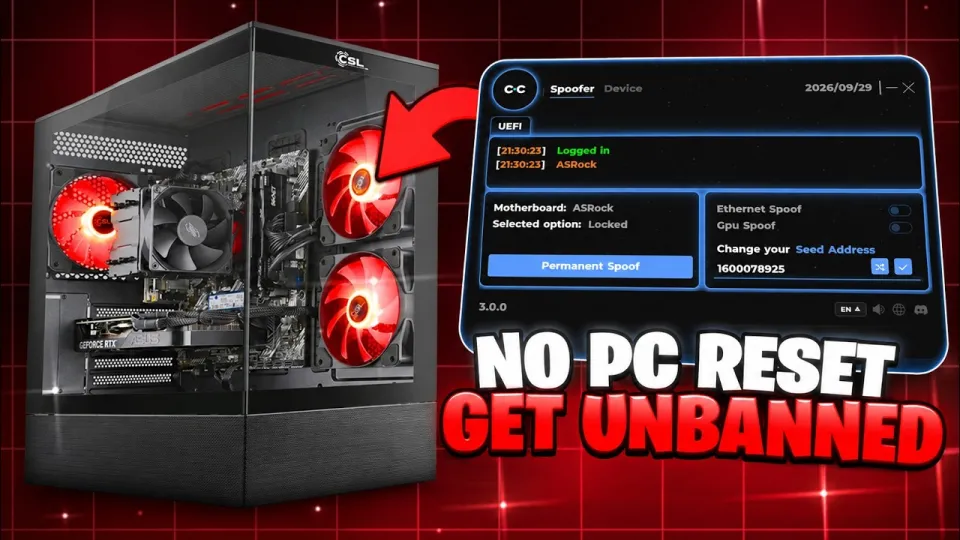
Video: The Ultimate HWID Spoofer Tutorial 2026 – Full Guide To Get Unbanned Fast
· based on the channel clixx
The best HWID spoofer is a tool that changes the hardware identifiers a game's anti-cheat reads, so a machine flagged by a previous ban no longer matches the stored fingerprint. In practice that means the software rewrites or masks values such as disk serials, motherboard and SMBIOS data, MAC addresses, and registry traces tied to your components. A walkthrough published by the clixx channel covers one such tool, available through the CethCheats store, and the guide below explains what these programs actually do, how setup usually runs, and where the real risks sit.
What an HWID ban actually tracks
An HWID ban is a block keyed to hardware and system identifiers rather than to your account, which is why making a new account often fails to lift it. Anti-cheat systems build a fingerprint from several sources at once: the serial number of your system drive, the volume ID of the Windows partition, motherboard and BIOS strings, the machine GUID in the registry, network adapter MAC addresses, and sometimes GPU and monitor identifiers. When a detection triggers a ban, that combined fingerprint is stored server-side. A new account logging in from the same fingerprint is matched against the list and blocked again, frequently within minutes.
This is the reason a spoofer has to touch multiple layers at once. Changing only the disk serial leaves the motherboard string intact, and the fingerprint still resolves. Good tools therefore present a checklist of components — disk, SMBIOS, registry, network, and sometimes EFI or boot-level entries — and let the user apply changes across all of them in one pass.
How the spoofer in the clixx tutorial is structured
The clixx video walks through the interface, configuration options and installation of a paid spoofer sold through cethcheats.cc. According to the video description, the review covers the tool's feature set, hardware ID configuration, the settings screen, installation, supported games and a functionality test. The chapter list runs from an overview at the start through features, configuration and the install process, so the whole flow is demonstrated rather than just described.
The supported game list given in the description is broad: Fortnite, Warzone, Rust, CS2, Rainbow Six Siege, Apex Legends and Valorant. That spread matters because different anti-cheats read different identifiers — Valorant's Vanguard is known for aggressive kernel-level checks, while Rust and Fortnite rely on their own detection stacks — so a tool that claims coverage across all of them is usually applying a wide set of changes rather than a single tweak. The store advertises a 5% discount with the coupon code DENYS.
Setting up a hardware ID spoofer step by step
Setup follows a predictable sequence regardless of which product you use, and skipping steps is the most common cause of a spoof that fails to hold.
- Disable or uninstall the game's anti-cheat client and close any background services tied to it, since a running driver can block writes to protected values.
- Create a restore point or full system image. Spoofers modify low-level identifiers, and a failed write can leave a machine unstable.
- Run the spoofer with administrator rights and let it detect the components it can modify.
- Select the identifiers to change — disk serial, SMBIOS, registry GUID, MAC address — and confirm the operation.
- Reboot, because most changes only take effect after the system reloads the values at startup.
- Verify the new identifiers with a system information tool before launching the game again.
Temporary spoofers revert on reboot, which is useful for testing but means the original fingerprint returns. Permanent modes write changes that persist, and some tools offer a backup of the original values so the machine can be restored later.
Permanent versus temporary spoofing
The choice between permanent and temporary modes comes down to how the anti-cheat stores and compares fingerprints. A temporary spoof changes identifiers for the current session only; once Windows restarts, the original hardware values come back and any ban tied to them applies again. That is fine for a single session but useless if you intend to keep playing.
Permanent spoofing writes the new values so they survive reboots. The trade-off is risk: a bad write to SMBIOS or disk serials can cause activation problems, driver errors or boot failures, and some anti-cheat systems flag mismatched or clearly synthetic identifiers as suspicious in their own right. Before committing, check whether the tool keeps a restore file, and store it somewhere other than the system drive.
Supported games and what to expect per title
Coverage varies by anti-cheat, and the description's list is a marketing claim rather than a guarantee. Valorant runs Vanguard at kernel level and is the hardest target; a spoof that works there usually involves deeper changes than one aimed at Fortnite. Rust and Apex Legends use their own detection systems with periodic hardware checks, so a spoof can hold at first login and fail later if a component was missed. CS2 and Rainbow Six Siege sit somewhere in between.
FiveM, the GTA roleplay platform, appears in the video's tags and is a common use case because server-level bans often key on identifiers. Whatever the title, expect to re-verify after each major anti-cheat update — patches routinely add new identifier sources, and a tool that worked last month may need an update to keep matching.
Risks, costs and the honest caveats
Every HWID spoofer carries two kinds of risk: technical and account-level. Technically, these tools modify kernel-adjacent settings, and a failed operation can break Windows activation or prevent the machine from booting. Account-wise, using a spoofer to evade a ban violates the terms of service of every game listed, and a fresh detection typically results in another ban — sometimes a longer one.
Cost is the other factor. Paid tools like the one reviewed by clixx are subscription-based, and the 5% coupon in the description does not change the recurring price. Free spoofers circulate widely but are a common vector for malware, since they request administrator access and low-level writes — exactly the permissions a payload needs. If you go ahead regardless, run the tool in a virtual machine first where possible, keep offline backups, and never disable your antivirus permanently.
Links from the video
- Store: https://cethcheats.cc/
- Discord: https://discord.gg/ceth
Final thoughts on choosing an HWID spoofer
The best HWID spoofer is the one that covers every identifier your specific game's anti-cheat reads, keeps a restore path, and gets updated after patches — not simply the one with the longest game list. The clixx breakdown is a useful starting point because it shows the interface, settings and install flow rather than only promising results, and it names the exact games the tool claims to support. Weigh the technical risk of low-level system changes and the certainty of terms-of-service violations before spending money. If you want to check the product shown in the video, the CethCheats website is where the tool and the DENYS discount code are listed.
Key takeaways
- HWID spoofing replaces the hardware identifiers anti-cheat systems use to link a ban to a specific PC.
- The software shown in the clixx breakdown is distributed through cethcheats.cc and its Discord server.
- Supported titles listed include Fortnite, Warzone, Rust, CS2, Rainbow Six Siege, Apex Legends and Valorant.
- A coupon code DENYS is advertised for 5% off at the store.
- Permanent and temporary spoofing modes differ in whether identifiers survive a reboot.
Questions & answers
What does an HWID spoofer actually change?
It modifies or masks the identifiers anti-cheat software reads to fingerprint a machine: disk and volume serials, motherboard and BIOS strings, the Windows machine GUID, MAC addresses and sometimes GPU data. A complete spoof touches several of these at once, because leaving one intact can keep the original fingerprint recognizable.
Is a free HWID spoofer safe to use?
Rarely. Free spoofers request administrator rights and low-level system writes, which is exactly the access malware needs, and they are frequently bundled with payloads. They also tend to go unpatched after anti-cheat updates. If you test one, do it on a disposable system or virtual machine with backups in place.
How long does a permanent HWID spoof last?
It persists across reboots until you restore the original values or reinstall Windows, but it is not permanent against anti-cheat updates. Patches regularly add new identifier sources, so a spoof that works today may be detected after the next update and need a tool update or a fresh pass.
Does spoofing work for Valorant and other kernel anti-cheat games?
Valorant's Vanguard runs at kernel level and is the most difficult target, requiring deeper changes than titles like Fortnite. Tools that claim support across Valorant, Rust, Apex Legends and CS2 usually apply a broad set of modifications, but results vary by patch and by how thoroughly each component is changed.
Source: The Ultimate HWID Spoofer Tutorial 2026 – Full Guide To Get Unbanned Fast · Markdown version